T’s diabetes care is now under Birmingham Children’s Hospital. This was done for a few reasons (mostly Brexit) but essentially as we will be moving back to the UK after 3 years, the right thing to do was to get him under a UK team for continuity.
Before I go any further, I need to acknowledge the team and how amazing they are. Imagine having a 24/7 phone number that you can call and speak to a specialist nurse, that’s what we have. It’s been a game changer in T’s care, no judgement when you call at 2am to ask for advice. These healthcare professionals are amazing.
The only catch with being under a UK team is that trips back to the UK are required, not only to see the team in-person but also to collect his Continuous Glucose Monitor’s (CGMs) and insulin pumps for the next 6 months. It isn’t possible to have them sent straight out to Italy.
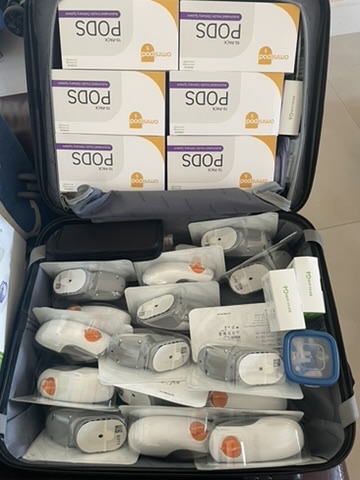
We recently made one of these trips back to the UK so I thought I would give some insight into what this looks like and how much equipment is required for 6 months:
Airport and Equipment
It’s important to check with the company that manufactures the equipment that you might use as to whether it can go through airport scanners.
To date, our experiences of airport security and travelling with lots of diabetes kit has only been positive, fortunately.
When flying back to Italy both times, we have been travelling with with a 6 month supply of CGMs and insulin pumps, as you can see from the photo above, that is a lot of stuff.
Unfortunately, it isn’t as simple as packing it all in hold luggage. Firstly, what happens if the bag goes missing?! Secondly, the CGMs and insulin pumps can’t go through x-ray scanners and thirdly, the temperature drops so much in the hold of an aircraft, it all needs to go in hand luggage. The effect of temperature dropping is especially true for insulin – it will freeze in the hold meaning that it cannot then be used.
As mentioned, the general advice for CGMs and insulin pumps is that they can’t go through x-ray machines and this is also true when it is in hand luggage. It needs to be taken out of the bag and decanted into a tray which is taken away and each item is individually swabbed for explosive residue. Yes, we are THAT family holding up the queue!
On this trip back I thanked the lady who swabbed it all and apologised for the sheer volume, explaining our situation. I continue to be surprised by the kindness of strangers, her response was that she was happy to do it and she even commented that we all need different things to keep us alive. How very true!
Another thing to consider is the type of scanner that we all walk through at Airport security. Gatwick now have the full body scanners which pumps and CGMs can’t go through. However, the websites that I have managed to look at do suggest that metal detectors are OK.
In our case, all I needed to do was explain to the security guard that T was wearing the CGM and the pump and they did a pat-down with his consent and swabbed his hands for residue. If you don’t ask, you don’t get!
Airlines and Type 1 Diabetes
All airlines have different policies for Type 1 Diabetes (T1D). All you have to do is goggle ‘Type 1 diabetes and flying’ and see newspaper articles about people being asked to leave the plane (before take off obviously) because their blood glucose was too low.
However, did you know that people with T1D can actually become commercial airline pilots now?
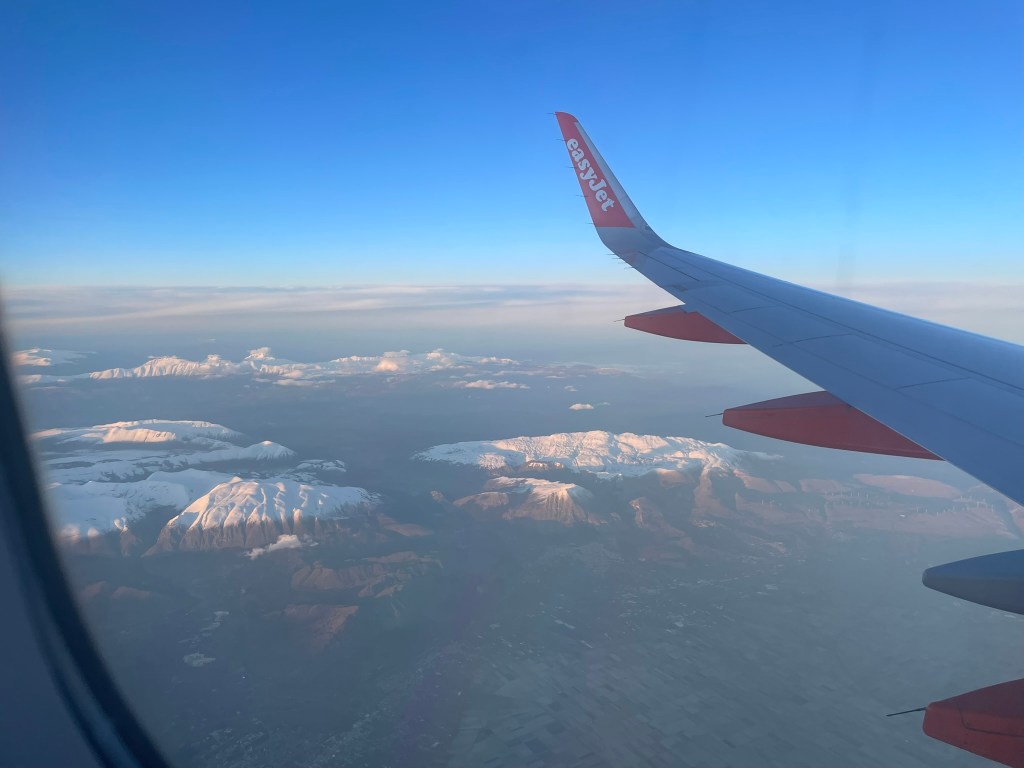
Anyway, I digress. The main reason that I am writing this section is because you are entitled to (free) hand luggage for medical equipment. Different airlines have different policies so it’s worth checking it out. We were flying back with easyjet, a quick email to them to explain the situation and, at no extra cost, they added on another larger hand luggage bag for T’s medical equipment. They were very specific about the need for a medical letter though and also what needed to be included in the letter. They also pointed out that nothing other than diabetes kit could be in the bag… fair enough.
The GP letter wasn’t even looked at, sorry Doc (especially after sending a detailed email about everything needed in it!), but if you need to request a letter in the UK to travel elsewhere, I would advise keeping in mind how long it might take for a GP to produce the letter.
Flying and Insulin Pump
It was only the second time that we have flown since T has had an insulin pump, but both arriving in the UK and Italy, he either had a hypo (low) on the plane or just after landing…. The first time it took us by surprise as levels had been great during the flight.
After looking into this a bit more, I wanted to share my findings.
Why does it happen?
Pressure – during take-off/landing the cabin pressure changes. In some situations, it can cause the pump to over-deliver insulin (therefore causing a hypo). Some websites suggest disconnecting your pump during these times, however with an omnipod (T’s insulin pump) that isn’t possible…
Some research in a hypobariac chamber showed that insulin pumps can over- or under- deliver by up to 1/2 unit of insulin during take off and landing and this was to do with bubble formation (Bertuzzi et al. 2017). However, this research is now 8 years old, I would like to think that manufacturers have taken this information and enacted some changes in their equipment.
More recent research looked at the use of insulin pumps on pilots using real world data in a retrospective study. Garden et al. 2025 concluded that insulin pumps are endorsed for use by airline pilots due to their clinical benefit but do acknowledge that insulin pumps did have bubble formation in flight simulation scenarios.
The take home message… it’s important to keep an eye on the numbers during a flight, especially during take-off and landing.
We haven’t done a long-haul flight yet and I’m not sure I have it in me at the moment to navigate more than one meal whilst in the air but one day it will come. As ever, the theme seems to be, prepare for the unexpected as it will probably happen. Take that extra vial of insulin, take that extra CGM and insulin pump. I think recent events in the world and people being stuck in the Middle East also cement this advice. What happens if the flight doesn’t go and you have to wait another few days to get home, do you have enough equipment?
Overall, the trip back to the UK was a success and we even managed 2 trips to Wagamama’s, a favourite of T. It also helps that Wagamama dishes (as well as a lot of high street chains) are on the Carbs and Cals app. Another plug for this app (not an ad, I just highly rate it) and its accompanying book.

Until next time.
Lx
 Beyond The Numbers